


Sevagram, Nagpur - Timings, History, Architecture, Best Time to Visit


 India | Maharashtra | Nagpur
 #24 of 26 Places to Visit in Nagpur
 Distance (From Nagpur): 76 Kms

 Trip Duration (Including Travel): 4 Hours/Half Day

 Transportation Options: Cab


 Travel Tips: None
At a distance of 10 km from Wardha, and 76 km from Nagpur, Sevagram is a small village located near Wardha in the Vidarbha region of Maharashtra. It is one of the top places to visit near Nagpur.
Sevagram, meaning 'Village of Service,' was home to Mahatma Gandhi's ashram and his residence from 1936 until his death in 1948. For several years, he lived there with his wife, Kasturba. After Sabarmati, Sevagram Ashram is especially significant because of Gandhi's residence there. While Sabarmati Ashram in Gujarat served as Gandhi's base during the early non-cooperation movement, Sevagram became the centre of India's final campaign for independence. During this pivotal decade, the Indian National Congress formulated, debated, and communicated all its major political decisions from this peaceful village in central India.
When Gandhi began his 1930 paadayatra from Sabarmati Ashram to Dandi for the Salt Satyagraha, he decided not to return to Sabarmati until India gained independence. He was imprisoned for more than two years. After his release, he travelled around the country for a time before deciding to establish his headquarters in a village in central India. On 5 August 1934, he arrived in Wardha at the invitation of his follower and industrialist Jamnalal Bajaj, and stayed for some time in a room at Bajaj's bungalow. In April 1936, Gandhi made his home in Segaon, a village on the outskirts of Wardha, and renamed it Sevagram. Seth Jamnalal Bajaj of Wardha provided the ashram with about 300 acres of land.
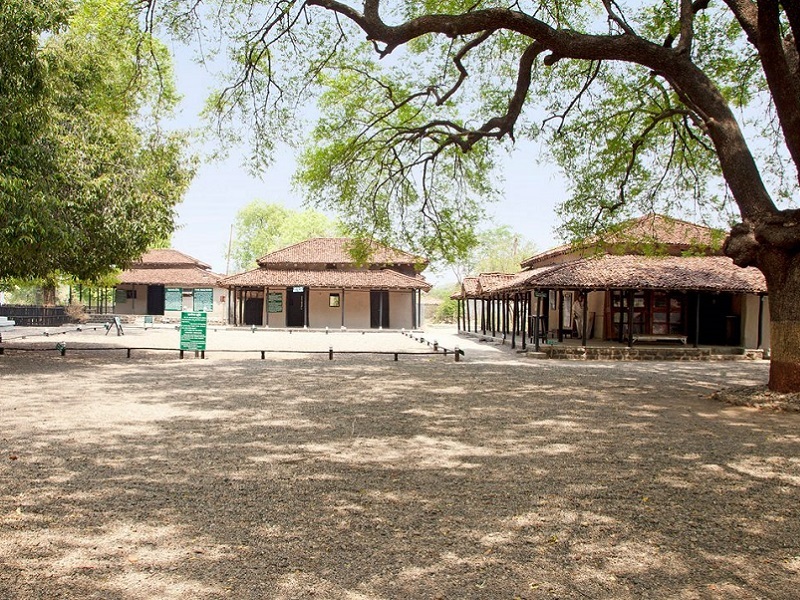
The small houses built at the ashram for Gandhi, his wife Kasturba, and his followers were modeled on traditional village homes. Gandhi built Sevagram Ashram himself using materials available locally. Adi Nivas was the first hut constructed at Sevagram Ashram, where Gandhiji lived with other members of the ashram in its early days. Ba Kuti and Bapu Kuti were the residences of Kasturba Gandhi and Mahatma Gandhi, respectively. Akhiri Nivas, meaning 'Last Residence,' is the hut where Gandhiji stayed for a few days before leaving for Noakhali. He never returned to the ashram afterward. The weighing machine he used during that period remains inside the hut. Parchure Kuti, Mahadev Kuti, Kishor Nivas, Rustom Bhavan, and other notable structures also stand within the ashram complex. A nearby museum preserves artifacts from India's freedom struggle.
Today, Sevagram Ashram is carefully maintained as a national heritage site by the Gandhi Smarak Nidhi trust. Each year, thousands of visitors-including students, historians, peace seekers, and curious travelers-come to walk the same grounds where Mahatma Gandhi spun khadi, meditated at dawn, and welcomed some of the world's most influential leaders. Yatri Niwas, built by the government in 1982, also provides accommodation for visitors.
Timings: 8 AM - 6 PM
Entry: Free