


Sri Krishna Janmabhoomi Temple, Mathura - Timings, Festivals, History, Darshan, Pooja Timings


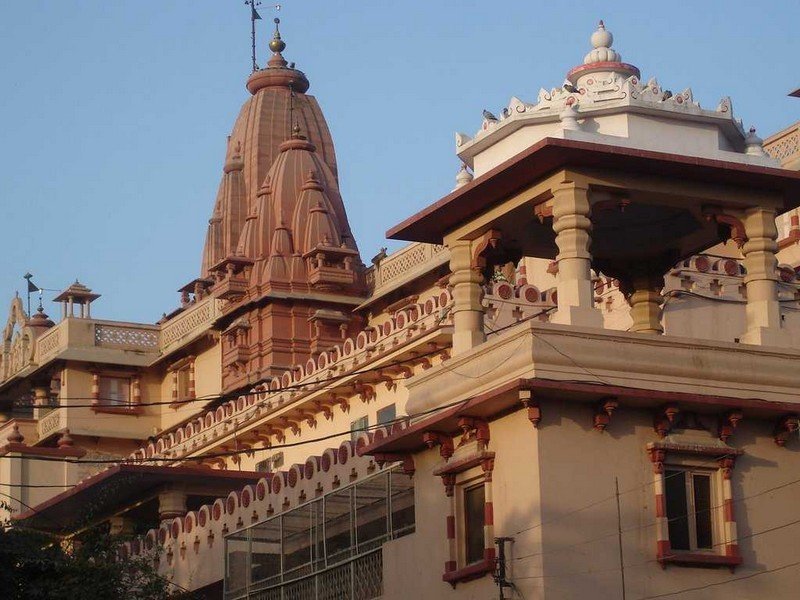
Photo Credit: Flickr

 #1 of 8 Places to Visit in Mathura
 Distance (From Mathura Jn Railway Station): 4 Kms

 Trip Duration (Including Travel): 2 Hours

 Transportation Options: Cab / Auto


 Travel Tips: None
About Mathura Sri Krishna Temple
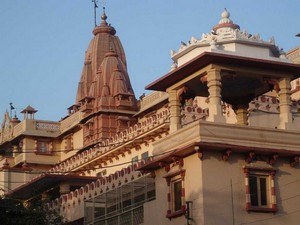
At a distance of 4 Km from Mathura Junction Railway Station, Sri Krishna Janmabhoomi is the most famous temple located in the crowded city of Mathura. Dedicated to Lord Krishna, the temple is the most important site for the followers of Lord Krishna and among the must-include places in the Mathura tour packages. Sri Krishna Janma Bhoomi also known as Katra Keshav Dev Temple is the actual birthplace of Lord Krishna. The temple is built around the prison cell in which Lord Krishna's parents, Mata Devaki and Vasudeva were imprisoned by his evil uncle Kansa.
History of Sri Krishna Janmabhoomi Temple
Sri Krishna Janmasthan Temple has been built around the prison in which Lord Krishna was born. It is believed that it was first constructed by the great-grandson of Krishna Vajranabha 5000 years ago. A bigger temple was constructed to replace the old temple during the reign of Emperor Chandragupta Vikramaditya in the 4th century CE. This temple used to one of the grandest temples in India until it was destroyed by Ghazni Mahmud in 11th century. In 1150 AD, Jajja during the rule of Vijay Pal Deva rebuilt the temple for the third time but the temple was destructed by other Muslim ruler Sikandar Lodi in 16th century. The fourth temple was built during the rule of Mughal emperor Jahangir by Veer Singh Bundela of Orchha. But it was again destroyed by Aurangzeb in 1669 AD and a mosque named Jami Masjid was built in the place of the temple. During British rule, Madan Mohan Malviya took the land from Raja Krishna das of Banaras. Later on, inspired by him few leading personalities like Jugal Kishore Birla, Jaidayal Dalmia and many others formed a private trust in 1951 to overtake the construction work on the site and finally the temple was completed in 1982.
Mythology of Sri Krishna Janmabhoomi Temple
The Sri Krishna Janmabhoomi Temple is of great significance to Hindus, as it is considered the birthplace of Lord Krishna. According to legend, King Vasudeva and his wife Devaki were imprisoned by Kansa, the ruler of Mathura, at this site due to a prophecy that foretold his death at the hands of one of Devaki's child. Kansa ensured that none of her children would survive. When Devaki gave birth to her eighth son, Lord Krishna the prison doors miraculously opened, and the guards fell into a profound slumber. Guided by divine intervention, Vasudeva transported Krishna across the Yamuna River to Vrindavan, where he entrusted him to Nanda and Yashoda, who had recently welcomed a baby girl. Vasudeva then returned to Mathura with Yashoda's daughter who is known as goddess Yogamaya, but Kansa attempted to kill her; however, she vanished in a miraculous manner. The temple has been built around the prison cell, which has gradually transformed into the magnificent structure that exists today.
Architecture of Sri Krishna Janmabhoomi Temple
The Sri Krishna Janmabhoomi Temple is comprised of three distinct sections: the Garbhagriha Shrine, the Keshavadeva Temple, and the Bhagvata Bhavan. The Garbhagriha Shrine is revered as the location of the prison cell where it is believed that Krishna was born. A marble pavilion and an underground prison cell have been constructed at this site, featuring a spacious veranda. Additionally, another temple dedicated to Ashthabhuja Yogmaya is situated near the entrance of the sanctum sanctorum. This temple shares a common wall with the Shahi Eidgah, necessitating that devotees undergo a security check.
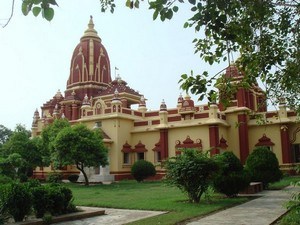
The Keshavdeva Temple was established by Ramkrishna Dalmia in memory of his mother, Jadiadevi Dalmia. The construction of this temple commenced in 1957 and was finalized in 1958 under the guidance of Hanuman Prasad Poddar. The Bhagavata Bhavan's construction began in 1965, with the installation ceremony of the deities taking place in 1982. This complex features five shrines, with the main shrine housing six-foot tall statues of Radha and Krishna, alongside the shrines of Balarama, Subhadra, and Jagannath on the right, and the temple of Rama, Lakshman, and Sita on the left. In front of the Jagannatha shrine stands the Garuda Stambha and Chaitanya Mahaprabhu, while Hanuman is positioned in front of the Ram shrine, along with the temple of Durga and a temple featuring a Shivalinga.
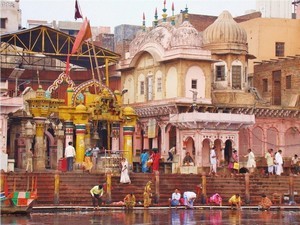
Furthermore, there exists a large stepped water tank known as Potra Kund or Pavitra Kund, located to the southeast of the Janmasthan temple, which is believed to have been utilized for the first bath of the infant Krishna following his birth. The steps of this tank were constructed by Mahadji Scindia in 1782 and were later restored by his descendants in 1850. Numerous artifacts, including utensils, ancient statues, and a rock-based slab, have been unearthed from this site. These artifacts are exhibited in a museum adjacent to the main temple, which is highly recommended for visitors.
Festivals of Sri Krishna Janmabhoomi Temple
The most important festival observed at Sri Krishna Janmasthan Temple in Mathura is Janmashtami, which commemorates the birth of Lord Krishna. This festival is the focal point of celebrations, taking place on the eighth day of the dark fortnight in the month of Bhadrapada, which usually occurs in August or September. It is marked by midnight prayers, aarti, and various special rituals. Additionally, Holi, known as the festival of colors, is celebrated with immense enthusiasm in Mathura and Vrindavan, often regarded as a celebration of the love between Krishna and Radha. Other notable festivals include Radhashtami and Diwali, all of which are celebrated with great zeal at the temple and across the Braj region.
Mathura Sri Krishna Temple Dress Code & Other Restrictions
Sri Krishna Janmabhoomi Temple in Mathura has a dress code that mandates visitors to don modest and traditional clothing. Men are expected to wear long pants, or dhotis along with shirts or kurtas, whereas women should opt for sarees, salwar kameez, or other forms of Indian attire that adequately cover the shoulders and knees. It is advisable to refrain from wearing Western garments such as shorts, skirts, and sleeveless tops.
Generally, non-Hindus are allowed to visit Sri Krishna Janmabhoomi Temple in Mathura. However, there may be restrictions on accessing certain areas or participating in specific rituals.
Sri Krishna Janmabhoomi Temple Timings
Monday: 5 AM - 12 PM & 2 PM - 8 PM
Tuesday: 5 AM - 12 PM & 2 PM - 8 PM
Wednesday: 5 AM - 12 PM & 2 PM - 8 PM
Thursday: 5 AM - 12 PM & 2 PM - 8 PM
Friday: 5 AM - 12 PM & 2 PM - 8 PM
Saturday: 5 AM - 12 PM & 2 PM - 8 PM
Sunday: 5 AM - 12 PM & 2 PM - 8 PM
Sri Krishna Janmabhoomi Temple Entry Fee
Entry is Free
Guided Tour is available for Rs. 200 - Rs. 300
Best Time to Visit Sri Krishna Janmabhoomi Temple
The best time to visit Sri Krishna Janmabhoomi Temple in Mathura is from October to March. During this period, the climate is pleasant, making it comfortable for visitors to explore the temple and participate in the festivities. For individuals wishing to experience the temple at its most spiritually enriching, it is recommended to schedule your visit during the Janmashtami festival, which commemorates the birth of Lord Krishna and generally takes place in August or September. The temple and the city become vibrant with intricate decorations, lively processions, and cultural displays. Another favorable occasion to visit the temple is Holi, the festival of colors, which typically happens in March. Nevertheless, it is important to note that the town experiences a surge of tourists during these festivals, so one should be ready for the bustling crowds. Mathura endures extremely hot summers and heavy monsoons, rendering those months less suitable for travel and exploration.
How to Reach Sri Krishna Janmabhoomi Temple
Agra Airport is the closest airport, which is 60 Km away from Mathura. Mathura Junction Railway Station is a major rail head with regular train services to Delhi, Mumbai, Ahmedabad, Hyderabad, Pondicherry, Vizag, Dehradun, Chandigarh, Trivandrum, Shirdi, Jammu Tawi, Chennai, Hubli, Goa, Patna, Lucknow, Bangalore and Chhattisgarh. Mathura is also well connected by road with Agra, Jaipur, Lucknow, Delhi, Indore and Allahabad. One can reach Sri Krishna Janmabhoomi Temple by hiring a cab, or an auto-rickshaw from all parts of Mathura.