


Avudaiyarkoil Aathmanatha Swamy Temple, Chettinadu - Timings, Festivals, History, Darshan, Pooja Timings


 India | TamilNadu | Chettinadu
 #12 of 15 Places to Visit in Chettinadu
 Distance (From Chettinadu): 42 Kms

 Trip Duration (Including Travel): 2-3 Hours

 Transportation Options: Cab


 Travel Tips: None
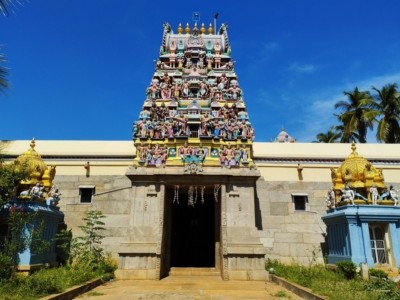
At a distance of 42 Km from Chettinad, and 44 Km from Karaikudi, and 48 Km from Pudukkottai, the Athmanathaswamy Temple, also known as Tirupperunthurai is a Hindu temple located in Avudaiyarkoil village near Aranthangi in the Pudukkottai district of Tamil Nadu. It is one of the top pilgrimage sites near Madurai.
Avudaiyarkoil Aathmanatha Swamy Temple is dedicated to Lord Shiva, referred to here as Athmanabhar, with his consort being Yogambikai. Notably, there is no actual granite representation of Lingam or Ambal, which is the reason this temple is called Avudaiyar Koil. The term Avudaiyar signifies merely the base of the Shiva Lingam! Constructed in the 10th century, the temple has undergone numerous renovations since its inception, with much of the current structure dating back to the 15th century AD. One of the revered texts of Tamil Saiva Siddhanta, Manikkavasagar's Tiruvasakam, is believed to have originated from this sacred site.
According to tradition, the temple is said to have been established by Manickavasagar. As per the legend, in the 9th century AD, Manikkavacakar, the chieftain of Arimarthana Pandian II, was tasked with procuring horses for the kingdom. During his journey, he encountered a guru who was chanting the name of Shiva. Manikkavacakar humbly prostrated before the holy man and requested to become his disciple. He entered into a profound meditation, and upon awakening, he discovered that the guru had vanished. It dawned on Manikkavacakar that he had been guided by Lord Shiva himself. Consequently, he utilized the funds intended for the horses to construct a temple in honor of the deity. When confronted by the king regarding the absence of horses or money, Shiva performed one of his divine sports, transforming a jackal into horses, which reverted to jackals once presented to the king.
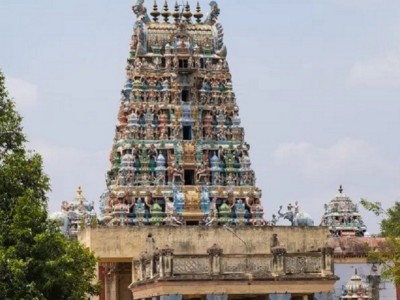
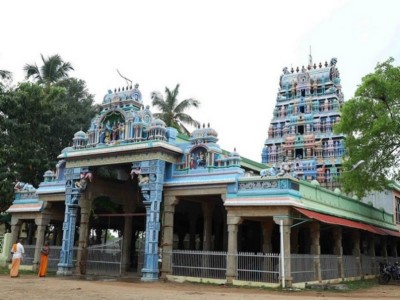
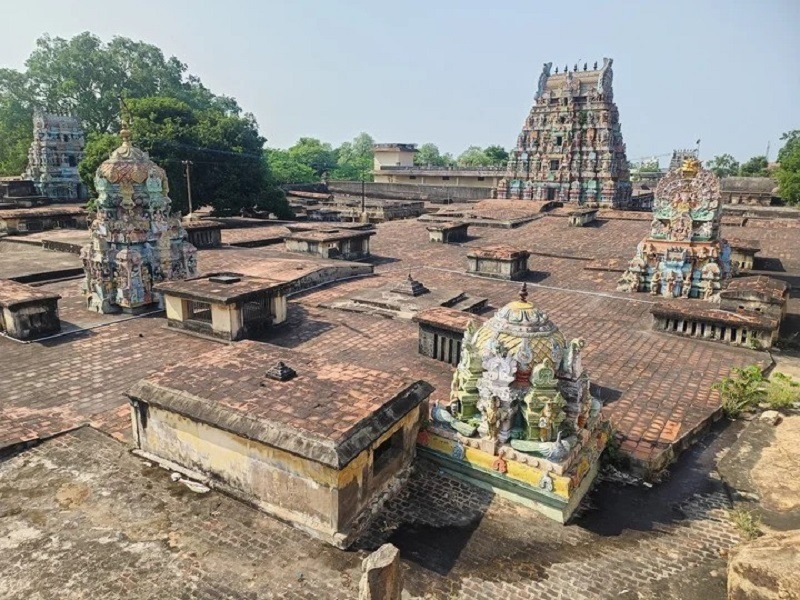
The Athmanathar Swamy Temple spans over 10 acres and features three enclosures, oriented towards the south. The architectural design of the temple allows the rays of the setting sun to illuminate the inner sanctum, despite being enclosed within three prakarams. The deity here is an Aroopan - formless. Instead of a Sivalingam, there exists only a pedestal (avudaiyar) situated in the sanctum. Behind the Aavudaiyar are three lights symbolizing the Sun, Moon, and Fire. In this temple, the God is positioned facing south in the form of Dakshinamurthy or Guru. The offerings made to Athmanathar Swamy are symbolic rather than literal. During the daily puja, freshly cooked parboiled rice is piled on the slab in the garbagriha or sanctum. The rising steam from the rice is offered to the lord.
The goddess Yogambal is also formless and is represented by the Yoga 'Peetham' or pedestal where her footprint is engraved. Rice cakes are placed beneath the bowl as an offering to her. Unlike most Shiva temples, there is no Nandi bull icon present, which carries profound spiritual significance. Hinduism permits the worship of deities for beginners. As one's devotion evolves, one starts to reflect on the formless nature of the Brahman. The temple has been constructed to exemplify this theological concept. It is one of the rare Saivite shrines in all of India that symbolically represents the supreme truth. Since the soul (athma) is formless, the deity is referred to as Athmanathar. In the sanctum, five lamps signify the five time scales, while 27 lamps represent the 27 stars. Additionally, the shivalingam and Nandi, along with other typical Shaivite elements such as the Dwajasthambam or flagstaff and shrines to the navagrahas, are absent here.
Tirupperunthurai is also referred to as Kokozhi, Sivapuram, Akasa Kailasa, Vadavur, Chaturvedamangalam, and Adi Kailasa in Sangam literature. It is known as Atita Sabha due to its six Sabhas: Kanaka sabha, Chit sabha, Sat sabha, Ananda sabha, Ratna sabha, and Deva sabha, in contrast to the five Sabhas found at Chidambaram. These halls feature exquisite carvings. It is believed that Manikkavacakar himself constructed these sabhas and adorned them with 21,600 copper plates. The depiction of Mother Parvathi in the Thillai Mandapa within the second prakara, bestowing the Pasupatha weapon to Arjuna as a hunter, is remarkably realistic in its craftsmanship.
The temple is renowned for its granite roofing. The ceiling of the Kanaka sabha is a magnificent creation in stone. The ropes, rafters, and nails are all fashioned from granite. The bow-wielding Muruga, Kali, and Siva's Rudra thandavam (wild dance) are exemplary specimens of sculptural art. The five philosophies represented by the Panchakshara, the five letters - Na, Ma, Shi, Va, Ya - Nivrtti Kala, Pratiśta Kala, Vidya Kala, Santhi Kala, and Santyatita Kala are sculpted on the roof of the Panchakshara Mandap. The Vijayanagara nayakas period paintings are found on the ceilings of 1000 pillar mandapam and Manickavasagar Shrine walls.
Among the annual festivals celebrated here are Tirumanjanam in June/July, and Thiruvadirai in December/January) each lasting ten days similar to those festivals in the Chidambaram Nataraja Temple.
Timings: 6 AM - 12 PM & 4 PM - 9 PM
Entry: Free