


Mathur Ainootreeswarar Temple, Chettinadu - Timings, Festivals, History, Darshan, Pooja Timings


 India | TamilNadu | Chettinadu
 #10 of 15 Places to Visit in Chettinadu
 Distance (From Chettinadu): 6 Kms

 Trip Duration (Including Travel): 1 Hour

 Transportation Options: Auto


 Travel Tips: None
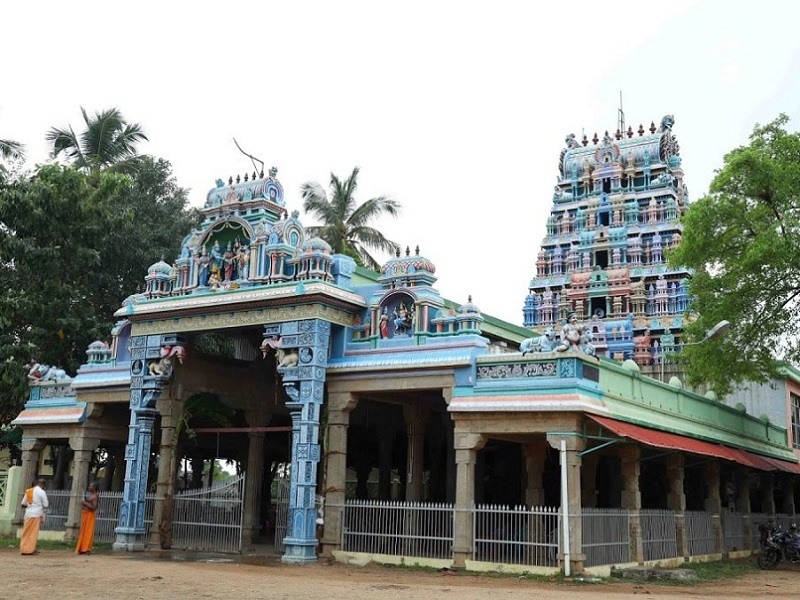
At a distance of 6 Km from Karaikudi, 16 Km from Chettinadu Railway Station, and 45 Km from Pudukkottai, the Ainootreeswarar Temple, commomly called as the Mathur Temple, is an ancient shrine located in Mathur in the Sivaganga district of Tamil Nadu, India. It is one of the top places to visit as part of Chettinad packages.
The Mathur Temple is dedicated to Lord Shiva who is worshipped here as Ainootreeswarar and his consort Arulmigu Periya Nayagi. This temple is one of the nine clan temples belonging to the Chettinad Nagarathar community. Furthermore, it is recognized as one of the Vaippu Sthalams mentioned in the Tevaram, specifically referenced in one of Appar's Tiruthandagams. Archaeological evidence indicates that both the temple and the settlement in the area have existed for over 1500 years. The current structure of the temple dates back to the 12th century CE. Historically, this location was known as Veerapandiapuram, likely named in honor of Veera Pandyan, a king of the Pandya dynasty.
The sthala puranam of this temple is intricately linked to that of the Thanthondreeswarar temple located in the nearby Iluppaikudi. Kongana Siddhar aspired to master the alchemical process of transforming iron into gold through a specific herbal mixture. Although Siva wished to prevent the siddhar from engaging in worldly pursuits, He ultimately decided to allow the siddhar to come to this realization on his own. Thus, He directed the Siddhar to worship Bhairavar at Iluppaikudi, enabling him to achieve the conversion of iron into gold. Subsequently, the siddhar returned to this location and, after considerable effort, managed to transform some iron into 500 gold tablets. While taking a break to quench his thirst, Siva appeared to him in the guise of an ordinary man, offering water and inadvertently kicking away the herbal concoction, which then disappeared. Understanding the Lord's intention, the siddhar promptly abandoned his aspirations of alchemy and began to meditate. Since Lord Siva manifested here when the siddhar had successfully created 500 (ainooru in Tamil) gold tablets, He is referred to as Ainootreswarar. The Tamil term for change or conversion is Maatram, and given that this was the siddhar's objective, the area came to be known as Maatrur, which has since evolved into Mathur.
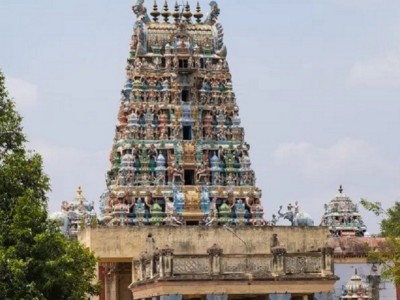
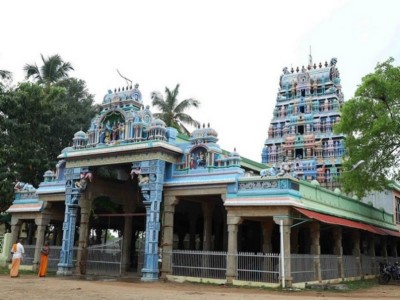
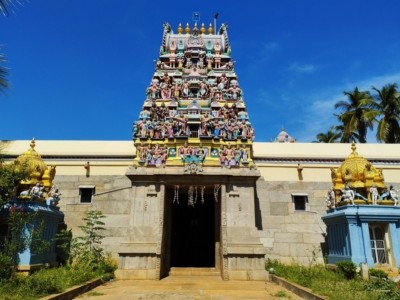
The architecture of Mathur Ainootreeswarar Temple showcases traditional Indian and medieval craftsmanship, highlighted by detailed sculptures and carvings that embody a rich cultural legacy. Rather than an external gopuram, there is a flat mandapam featuring a stucco entrance. This mandapam is a relatively modern addition, as the temple's original gopuram is located at the far end of this mandapam.
The temple comprises a sanctum sanctorum, antarala, and ardha mandapam. The sanctum sanctorum is oriented towards the east, and within the koshtam are the customary vigrahams of Vinayakar, Dakshinamurti, Annamalaiyar, Brahma, and Durga. The entire prakaram is visually stunning, with pillars adorning the full perimeter on both sides. Within the prakaram, one can find Vinayakar, Bhikshatanar, Murugan accompanied by his consorts Valli and Deivanai, Sivas as Kasi Viswanathar alongside Visalakshi Amman, Somaskandar, Gajalakshmi, Chandikeswarar, Bhairavar, Chandran, and Suryan. Additionally, there is a distinct Navagraham shrine. In the southern section of the prakaram, the vigrahams of the 63 Nayanmars are arranged in a line, led by Pattinathar.
Timings: 6 AM - 12 PM & 5 PM - 7:30 PM
Entry: Free