With a history that extends over 5000 years, India is a vast and diverse country that features numerous fascinating historical monuments and cultural heritage sites, which quietly tell their stories of joy, sorrow, courage, and sacrifice to those who visit. These marvels encompass palaces, forts, grand monuments, temples, and caves. Among these, the Ajanta Caves consistently rank highly. These ancient caves serve as guardians of historical narratives that span several centuries and exemplify the extraordinary cave architecture found in India. Importantly, these caves have received the esteemed recognition of being designated as UNESCO World Heritage sites. Attracting millions of tourists each year, the Ajanta Caves are among the most visited heritage sites in India and are vital components of Maharashtra Tour Packages. Exploring the details of these extraordinary heritage monuments reveals a rich tapestry of lesser-known stories and legends that surround them.
Dating back to the pre-Christian era
Thought to have existed since the pre-Christian period, the Ajanta Caves comprise a collection of 30 rock-cut Buddhist cave monuments that date back to the time frame between the 2nd century BCE and 650 CE. As noted by historian Walter M. Spink, the construction of the Ajanta caves occurred in two distinct phases. The initial phase, which took place during the Satavahana dynasty, saw the creation of Caves 9, 10, 12, 13, and 15A, which are associated with the Hinayana Sect of Buddhism. The subsequent phase of construction was conducted under the reign of Emperor Harisena of the Vakataka dynasty. Following the conclusion of Harisena’s rule, the Ajanta Caves were abandoned and enveloped in dense forest until their rediscovery by a British officer in 1819. The Ajanta Caves are one of the most visited places in Maharashtra as part of Ajanta tour packages.
UNESCO World Heritage Site
The rock-cut cave monuments of Ajanta Caves comprise marvelous paintings and eye-catching sculptures that are considered to be masterpieces of both “Buddhist religious art” and “universal pictorial art”. Owing to its fine murals, Ajanta – Ellora Caves were combined to form a UNESCO World Heritage Site in 1983 and is now considered to be one of the most important heritage sites near Mumbai. It is also a protected monument which is taken care by the Archaeological Survey of India (ASI).
Striking Architecture & Ornamentation
With a height of about 76 m, the Ajanta Caves are excavated in a horseshoe-shaped rock surface overlooking the Waghora stream. There are about 30 caves in total including an unfinished one. Out of these, five caves are chaityagrihas while the rest are viharas. With regard to date and style, the earliest excavations belong to the Hinayana sect of Buddhism. Stupas are the object of worship in these caves. The caves have been carved such that they seem to imitate the details of wooden construction.
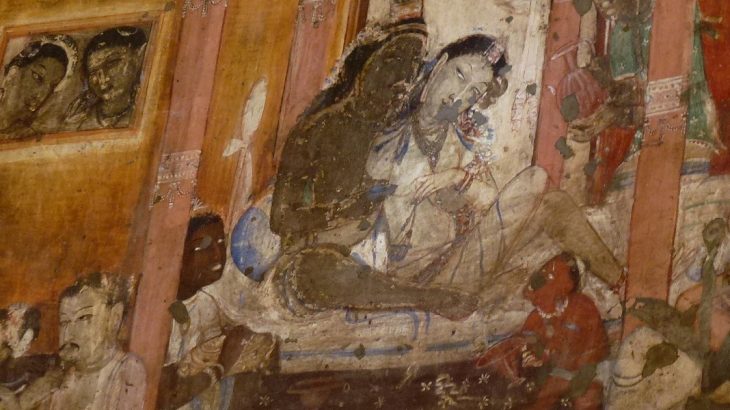
The second phase of cave construction is different from the earlier one in terms of pattern and layout. It involves depiction of Buddha image, both in sculpture and painting. The main theme of paintings in the caves is the illustration of various Jataka stories and events from the life of Buddha. The base surface of the paintings on walls and ceilings consisted of a rough layer of ferruginous earth mixed with rock-grit or sand, vegetable fibres, paddy husk, grass and other fibrous material of organic origin while the surface was finally worked with a thin coat of lime wash. Over the lime washed surface, outlines were drawn boldly and spaces were filled with essential colors in different shades and tones to achieve the effect of rounded and plastic volumes. The colors and shades used were red and yellow ochre, terra verte, lime, kaolin, gypsum, lamp black and lapis lazuli. The main binding material used in the paintings was glue.
Magnificent Mural Paintings
The caves at Ajanta is one of the renowned Buddhist monuments in India. These caves are famous for beautiful mural paintings and sculptures that epitomize Buddha and various Jataka tales. The general style of paintings at Ajanta Caves seems to have influenced paintings in Tibet and Sri Lanka.
The world famous paintings at Ajanta Caves also fall into two broad phases. The earliest is noticed in the form of fragmentary specimens in Cave 9 & 10, which are datable to 2nd century BC and the second one could be noticed in the form of exemplary paintings of Vakataka period in Cave 1, 2, 16 and 17. The artwork in the caves comprises well preserved wall paintings of Bodhisattva, Padmapani and Avalokiteshvara. Various incidents from the life of Gautama Buddha and the Jataka Tales are represented and recreated on the walls of these caves. Scenes from the royal court of the respective eras are also painted.
Most Visited Ancient Monuments in India
The enthralling caves of Ajanta and Ellora in Maharashtra are the epitome of beauty. Representing both Theravada and Mahayana Buddhist traditions, the rock-cut caves have magnificent paintings which are the finest example of impressive Indian artistry that existed in the foregone era. Owing to its beautiful sculptures and paintings, Ajanta Caves attracts millions of domestic and international tourists every year and are considered to be one of the most visited ancient monuments in India. Usually, Ajanta Caves can be visited along with Aurangabad and Ellora Caves as part of Aurangabad Tour Packages.
Most Popular Tour Packages
Similar posts:
 20 Wonderful Places to Visit in Monsoon in India
 5 Reasons to Consider Chikmagalur for your Upcoming Trip
 10 Stunning Places to Visit in Bali
 Most Popular Indian Festivals & Events in January
 6 Most Spectacular Festivals of Karnataka
 5 Beautiful Places that can be visited along with Coorg
 5 Most Popular Treks near Shimla
 Most Famous Temples in Jaipur
 5 Amazing Short Treks in & around Nainital
 12 Best Budget Workation Destinations in India


